
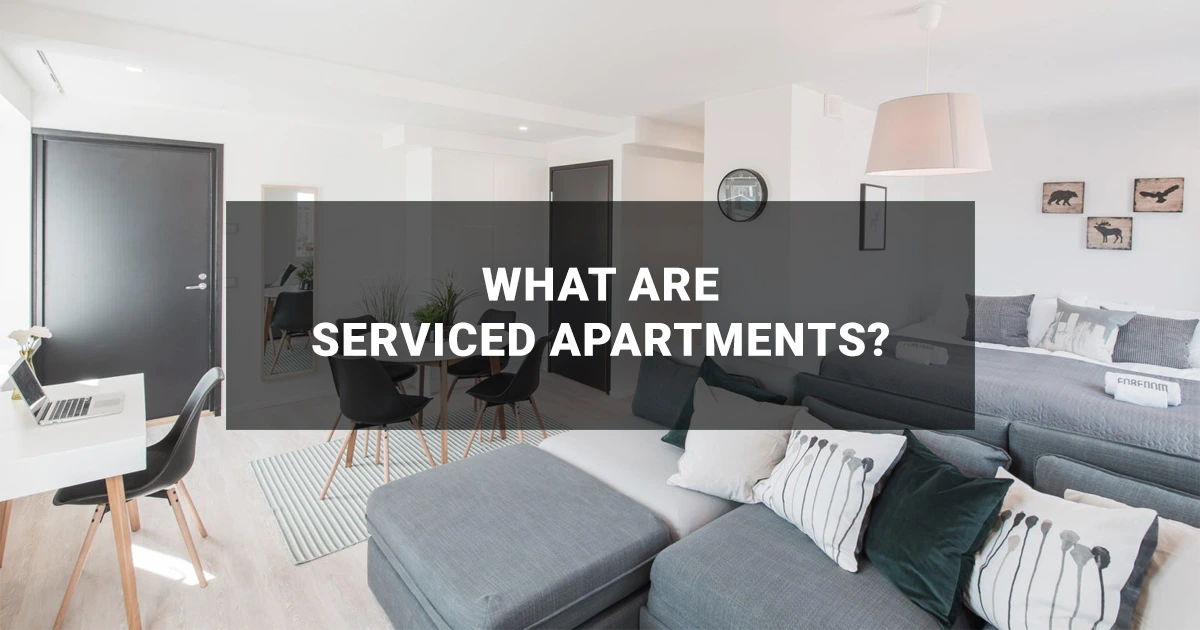
Serviced apartments are now an accommodation choice for business people, expatriates, relocating families, and any long-stay guest type.
They occup position somewhere between hotels and residential apartments and offer a peculiar hybrid of comfort, flexibility, and professional services. With expanding urban mobility and changing working patterns, the very concept of what a serviced apartment is and how it operates has grown in relevance.
The blog delves extensively into service apartment meaning, including their definition, specifications, operating model, benefits, drawbacks, and types of tenants who can benefit from such an arrangement.
See also: Co-living in Bangalore: The New Face of Urban Housing in 2026
What Is a Serviced Apartment?
Basically, serviced apartments are furnished apartments that one could occupy for two days or two months, offering hotel services with the privacy and space of home. These apartments offer more than just renting standard apartments; they come with modern fixtures, furnished housekeeping, maintenance, and utility services, all without charge to the customer.
Simply put, the serviced apartment meaning stands for ready-to-move-in apartments in which daily living needs are managed professionally, allowing the occupant to concentrate on business, travel, or leisure without having to worry about traditional rental responsibilities.
Key Features of Serviced Apartments
Serviced apartments are defined as units that have the capability of ready living and that include, among other features:
- Furnishing: At least well furnished Interior with beds, sofas, wardrobes, dining furniture, and amenities.
- Kitchen: Equipped with utensils, cookware, refrigerator, and microwave.
- Housekeeping: Having regular housekeeping (may be daily or weekly, depending on the operator).
- Utilities: Included are utilities such as electricity, water, internet, and cable TV.
- Maintenance: On-site or on-call maintenance support.
- Security: Some of the security features offered are CCTV, controlled access, and front desk service in most properties.
Such features mainly attract most guests into the serviced apartments, especially when in for long stays. Indulging in comforts, one would wish to live this convenient lifestyle for shorter periods.
See also: Flat vs Apartment: What’s the Real Difference? A Complete Guide
How Do Serviced Apartments Work?
Serviced apartments are very different from hotels or traditional rented homes when it comes to the operational model.
Booking and Tenure
These apartments can be booked for very short periods, for a few days, or, if required, for a few months up to a couple of years, or even more. Reservations are generally made via:
- Property management companies
- Corporate housing providers
- Online bookers
- Direct arrangements with serviced apartment operators
Unlike traditional rental agreements, these generally do not involve a long-term rental contract, a security deposit, or much other documentation at all.
Pricing Structure
Serviced apartment costs are usually categorized in the following manner:
- A daily rate for short-term stays
- A weekly or monthly rate for extended stays
This pricing usually includes furniture, utilities, housekeeping, and maintenance, making serviced apartments far more transparent than normal rentals.
Services and Management
These apartments are run by professional operators, ensuring that their operation and service delivery remain constant. Tenants do not interact with landlords directly; all complaints and issues are consolidated into one management system.
Types of Serviced Apartments
Really versatile, serviced apartments come in various forms suitable for varied needs:
Studio Serviced Apartments
Ideal little apartments for lone professionals or short-term business travellers.
One-Bedroom Serviced Apartments
Good for couples or executives who need a fair degree of privacy and space.
Multi-Bedroom Serviced Apartments
Best suited for families, relocation stays, or group occupancy.
Luxury Serviced Apartments
The super-luxury premises with the best quality interior, concierge services, fitness centre, and business facilities.
Benefits of Serviced Apartments
In serviced apartments, certain perks are available for choosing them over any traditional forms of accommodation.
Spacious Accommodation
Servicing apartments provide more living space, with proper separation of bedroom, living area, and kitchen compartments from a hotel model.
See also: What Is a Common Area in Apartments? Meaning & Examples
Better Rates During Prolonged Stays
The servicing apartments may appear to have higher rates in the beginning, but during a prolonged stay, it becomes very economical when compared with hotels on account of various services included and ancillary expenses being lower.
Flexibility
The guests may keep on extending or cut short their plan with minimal formality; thus, they suit best for projects with uncertain timelines or relocations.
More Privacy and Freedom
In these apartments, residents get the option to live their own private life without constant intervention from the hotel staff.
Living in a Way That Feels Like Home
Cooking, entertaining, and living in a familiar manner go a long way in ensuring that one remains comfortable on a long-term stay.
See also: Expert Analysis: Independent Floors or High-Rise Apartments in Gurgaon & Bangalore
Serviced Apartments vs Traditional Apartments
| Aspect | Traditional Apartment | Serviced Apartment |
| Furnishing | Usually unfurnished | Fully furnished |
| Lease | Long-term rental agreement | Flexible stay duration |
| Services | Tenant-managed | Professionally managed |
| Utilities | Paid separately | Included |
| Maintenance | Tenant responsibility | Operator-managed |
| Ideal For | Permanent residents | Short and long-term occupants |
What Are the Disadvantages of Service Apartments?
Some drawbacks exist concerning serviced apartments, despite their advantages.
- For long-term stays, these apartments are higher priced compared to normal rentals.
- Less personalization on the interior; standardized interior design.
- Less availability during the peak demand period in the area.
- Certain restrictions and rules are imposed by the operators, such as guest policies.
For those requiring permanent accommodation, perhaps conventional rentals would be a better option due to greater flexibility for personal customization.
Who Should Choose Serviced Apartments?
Serviced apartments fit best for:
- Corporate executives on short assignments
- Expatriates and NRIs who are moving to another city
- Medical tourists and medical travelers
- Families currently without possession of landed property
- Consultants, freelancers, and professionals working on projects
Because of their flexible and comprehensive service, they suit the needs of people interested in convenience and efficiency.
See also: Flat Handover Checklist in India 2026: Documents, Rights & Legal Guide for Buyers
Legal and Regulatory Considerations

In several countries, serviced apartments are allowed to operate under hospitality or mixed-use regulations rather than residential tenancy laws, thus enabling operators to provide short-term stays legally while still offering an apartment stay for residential purposes.
Occupiers should check for:
- Local zoning compliance
- Tax implications for long-term stays
- Terms of service and cancellation policies
Safety and Security
Safety is one of the prime factors for admission at a serviced apartment. In fact, an appropriate type of serviced apartments considers safety features like
- 24/7 surveillance systems
- Gate/ entry points are secured
- Staff and/or concierge services
- Fire safety and emergency precautions
Thus, these apartments are indeed credible and safe forms of accommodation as long as the operator is reputable.
Conclusion
In the classification of modern lodgings, serviced apartments mingle with the conventional domain of hotels and homes. Flexibility, comfort, and professional management help meet the newly emerging needs of the mobile workforce and long-stay travellers.
An understanding of what a serviced apartment is, how it operates, the advantages and disadvantages, is helpful in making the right choice for an individual or organization. These apartments are really practical choices for anyone, from individuals wanting convenience and privacy in a home-like atmosphere, without a long-term commitment.
FAQ’s
A serviced apartment is characterized as being fully furnished, comfort-oriented, and made available for short-term and long-term stays, with services akin to hotels, such as housekeeping, maintenance, and utilities included in the price.
A traditional apartment is leased typically for a longer term and may involve self-management of living in the leased premises, while a serviced apartment allows a flexible duration for stay with professional services included.
These apartments may put a heavier dent in the pocket than regular rentals, which allow some limited personalization, but the company operating them may impose rules.
Minimum of a few days and may extend for months or more, depending on the operator and applicable local regulations.
Generally, these apartments are perfectly safe under a professional operator that adheres to proper security and maintenance standards.